
Don't Be Hysterical!
Coal Mines, Glass Elevators, and the Myth of Biological Destiny

For a while now, I’ve been tracking the proportion of women in the Hungarian Parliament and among the full members of the Hungarian Academy of Sciences, and it tends to generate quite a bit of pushback.
Curiously, only from men.
I regularly get asked: “But what about the coal mines?”
What I don’t get asked is: “What about the laundry rooms, daycare centers, and schools?”
The critics come at me with genetics and evolution, sending all kinds of non-replicable studies with tiny sample sizes and slightly manipulated data, while conveniently forgetting about sociology and social psychology.
Cherry picking at its best.
I’m afraid I can’t help seeing this as mansplaining and whataboutism, but before I get into that, let me quickly show you this year’s results:
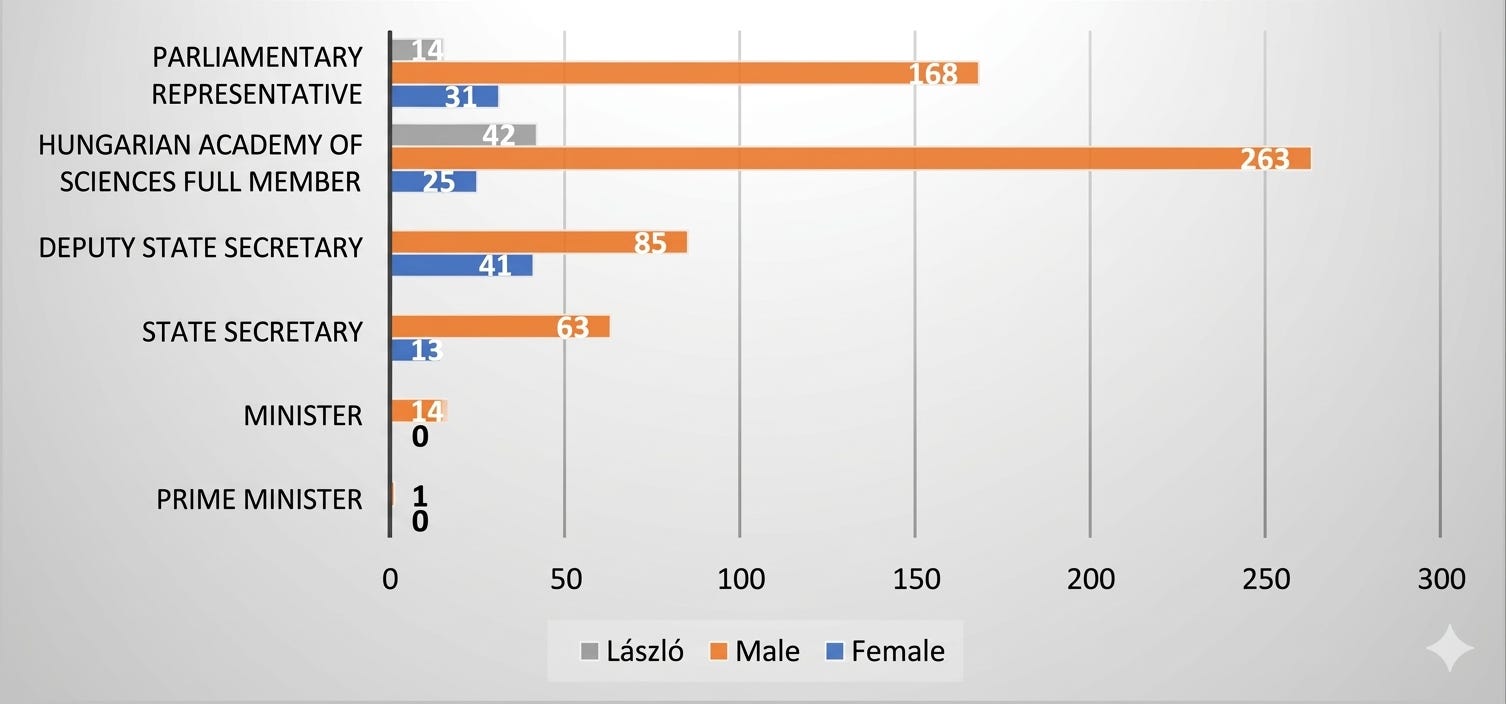
As a researcher and scientist, it’s not just that men have a better chance of reaching high positions; someone named László already has a head start in a research career.
Of course, this isn’t a causal relationship, and a boy named László born today wouldn’t have much chance on these tracks three or four decades from now. The name isn’t very common anymore, and it hasn’t been for a while, but 30-40-50 years ago, it was.
I also keep a close eye on the Global Gender Gap Report.
Since 2006, the World Economic Forum has compiled a comprehensive study every year. In 2007, 128 countries participated; in 2025, 148 countries were included. The report evaluates countries based on how well they distribute resources and opportunities between their male and female populations, regardless of the overall level of those resources and opportunities.
They examine four areas: Economic Participation and Opportunity, Educational Attainment, Political Empowerment, and Health and Survival.
Here are our results.*
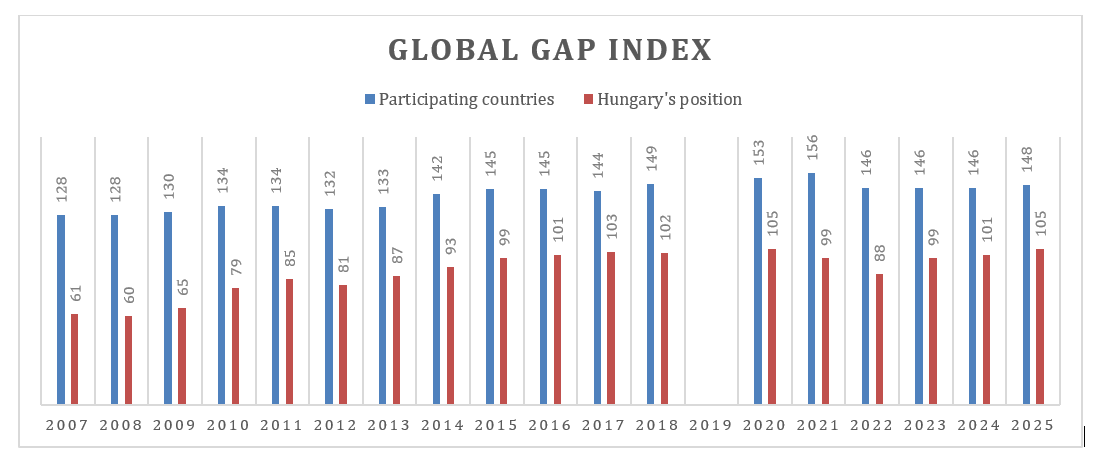
(*I couldn’t find 2019 data.)
So, dear Women!
With a capital W.
Be happy that we cherish you, that we watch over you, that we protect you.
Of course, you wouldn’t need so much protection if it weren’t for us: the very people you need protection from.
But we’re here, so we’ll protect you.
As long as you accept your place. (This is called benevolent sexism.)
But the moment you can’t do that, we start to resent you. (This is called hostile sexism.)
So just don’t be hysterical, there’s nothing to see here, be grateful you don’t have to work in coal mines.
Never mind that you won’t reach high-level careers because you’ll hit your heads on the glass ceiling while we, men smoothly (not smoothly at all, at breakneck speed) ride up in our glass elevators.
But beyond that, women’s real problem isn’t just this. It’s that they’re exploited at work just as much as at home, and on top of that, they’re the ones caring for elderly and sick relatives.
And let’s not forget the number of women suffering from physical, psychical, and sexual abuse. In Hungary, at least one woman dies every week due to intimate partner violence. That is one woman every week, murdered by a(n) (ex)husband, a(n) (ex)partner, or a family member. The latency of sexual and psychological violence is appallingly high, and it has been declared that this government will not ratify the Istanbul Convention.
“Hysterical” as a Female Label
Interestingly, the label “hysterical” is only applied to women and girls. We never use it for men and boys, even when they exhibit exactly the same behavior. Well, sometimes we do use it for them, but then we say: “You’re acting like a girl.” Because being a girl, in this context, is an insult.
When a female politician protests loudly, when she reacts with emotion, when she stands up for justice, for her beliefs, we hear: hysterical, emotional, overreacting, can’t handle the pressure. The same behavior in a male politician signals determination, strength, consistency. Such a man stands up for his principles.
This doesn’t start in politics. It starts around the time people begin planning to have children. Actually, even earlier, because parents already relate differently to boys and girls in their own childhood. And of course, to themselves. So during pregnancy, we assign significance to how the baby kicks, how it settles, and as a newborn, we can already tell from looking whether the child is smart (boy) or cute, sweet (girl).
And this continues in childhood, at the playground, in preschool, at home, when we comment on a little girl’s crying with “stop being hysterical, nothing’s wrong, you’re overreacting,” when we dismiss a girl’s anger with “don’t be so emotional, why are you whining?”
British scientists (real ones) conducted an important and troubling study. They placed a child who could already sit up on a carpet filled with toys. Some children were dressed as girls, others as boys, regardless of their actual sex. A research subject sat down with them who knew nothing about this and began playing with the child on the carpet according to how they perceived them. If they thought they were playing with a boy named Thomas, they gave him boy toys. If Thomas, who was actually Susan, played with something soft and plush, they took it away and gave her a toy train instead.
The same thing happened in reverse.
In toy stores and clothing stores, it’s very difficult to shop gender-neutrally. Pink aisles await little girls with dolls, kitchens, vanity tables, and princesses in sparkly dresses. The message is clear: girls must be beautiful and nurturing. In my son’s preschool, they furnished the room according to gender ratios. So lots of dinosaurs and cars ended up in the room and very few kitchens and dolls, which naturally resulted in all the children crowding around the “girl” toys.
Language Shaped by Gender
Our language is not neutral at all. So when we tell a girl not to be hysterical, we’re sending her the message that her feelings aren’t valid. When she argues, stands up for herself, and we say “look how cute, what a stubborn little kitten,” we’re not taking her seriously. We’re invalidating her. And when we reinforce her much more in nurturing, emotional, caring situations, we’re reinforcing in her that logical, measurable, rational, athletic, performance-based things aren’t her territory.
A good little girl is quiet, kind, smiling, helpful, patient, cooperative, someone who doesn’t say no. Preschools and schools reinforce this behavior, expect this behavior from them.
Another British study found that teachers call first-grade girls “love” more often, while boys are called “mate”. Gender even plays a role in making diagnoses.
For example, society accepts aggression and scatterbrained behavior much more from boys than from girls, which means a girl with ADHD will compensate for her behavior much more, which means her ADHD can remain hidden more easily, which means she gets help more slowly.
But anyway.
Why should a girl have to be quiet? Why can’t she be loud, brave, rebellious? Why should she have to smile when she’s sad? Why can’t she play with cars and numbers? Why can’t she be dirty in the preschool yard?
There’s no such thing as boyish courage, boyish curiosity, boyish interest, boyish openness, boyish intelligence, boyish emotion.
Just as there’s no such thing as girlish patience, girlish attention, girlish care, girlish nurturing.
Girls Should Be Pretty. Smart? Preferably Not.
We very often reinforce girls for their appearance, most often unconsciously, in their appearance, their attributes. Much less in their capabilities. She draws nicely, plays nicely, builds nicely, sits nicely, eats nicely. And she should do all this carefully, so it doesn’t become boyish. Her drawing, her construction, her play, her sitting.
From a very young age, girls are present in the world through their bodies, and of course they would be present through their minds too, but that’s not really allowed. Expectations don’t permit it much.
The Pink Tax
Since girls are present in the world through their bodies, their lives are much more expensive.
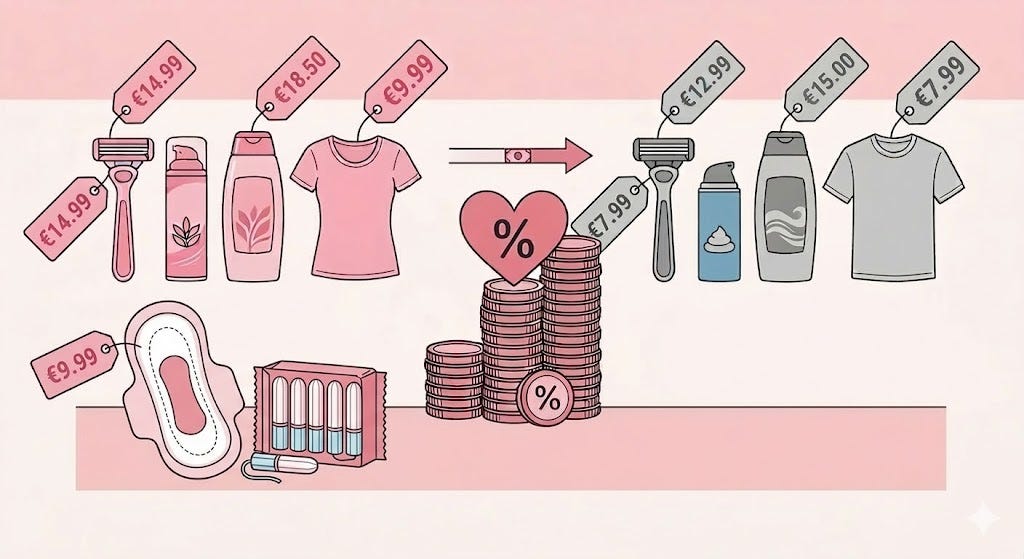
Girls menstruate for decades; this is a cost that men don’t have to account for. If feminine hygiene products carry the same VAT as all other products, that’s a serious injustice.
That’s why many countries have lower VAT on these products, many countries don’t tax these products at all, and in some countries, they’re even free.
Menstrual poverty is a serious issue across the globe.
Many places are looking for solutions. Hungary doesn’t differentiate here.
But it’s worth broadening the context, because this isn’t the only area where women suffer disadvantages.
Because if store designers measure shelves to the average male height, if car seat belts are designed for male physiques, if optimal temperature is set for male comfort, if women’s clothes, razors, creams, and soaps are on average more expensive than similar products for men, if various tech and household devices are made to fit the average male palm and fingers, if healthcare is fundamentally male-centered (meaning it studies phenomena observed in men and then tries to apply the results to women) except for a few female-specific diseases, then women suffer disadvantages.
Invisible ones and very visible ones, serious disadvantages that can even threaten their lives.
Genitals Don't Define Us
Genitals are important organs: we pee with them, have sex with them, and conceive children with them, but beyond that, they don’t have much function. From having a penis or vagina, roughly one trait follows, and even that’s not entirely clear. After all, men can pee sitting down too. In the morning, half-asleep, who the hell wants to stand?
And of course, someone with a penis is unlikely to get pregnant, give birth, or breastfeed, but psychological traits don’t follow from genitals.
Not a single one.
A vagina doesn’t mean you’re weak, doesn’t mean you’re sensitive, doesn’t mean you’re nurturing, doesn’t mean you’re passive, doesn’t mean you want to be pretty, doesn’t mean you want to be quiet.
But society forces this.
This is the expectation at school, this becomes the expectation at work.
That’s how we end up with 42 Lászlós among the full members of the Hungarian Academy of Sciences but only 25 women, not a single female minister, and we say, well, women just aren’t ambitious enough. But this isn’t about ambition. It’s about what we teach them in childhood, about what messages we send them every single day, about what kind of world we build for them, what kind of world we let them move in.
A world where they cook, but master chefs are men. A world where they cut hair, but master hairdressers are men. Unfortunately, everyone shops at fast fashion stores, but when these items need mending, it’s women who sew them; fast fashion products are made by women, yet the great fashion designers are men. Female preschool and elementary teachers, but principals, especially in high schools, are already men. The higher we go, the more men and Lászlós there are.
So don’t come at me with the coal mines!
What Can We Do?
First of all, this matters not just for girls and women, but for boys and men too. How we talk with and about girls and women affects boys and men as well.
But we have our work cut out for us, because gender roles are deeply embedded in our language, our culture, the toys, the expectations. They’re truly everywhere.
There’s no such thing as gender neutrality.
But there is gender awareness.
And that starts with our own language, our own reactions.
When your daughter cries, don’t tell her not to be hysterical. Say “I see you’re sad, what happened?” When she chooses a toy, don’t say “that’s a boy’s toy.” Say “try it if you’re interested.” Don’t focus on her body, but on her capabilities. Don’t say “you’re so pretty,” say “you did that so well.” Don’t say “your dress is so cute,” say “you should be so proud of yourself.”
Let her be loud, let her be herself, let her express her needs, because a girl who learns that her emotions matter, who learns that she — her personality — matters and not her gender, will be able to speak up as an adult woman when something is wrong, when something hurts her. A girl who learns that her capabilities matter will achieve things. A girl who learns she doesn’t have to be silent, that she’s allowed to refuse, will speak, will lead, will decide.
And then maybe one day there won’t be just 25 women among the 288 full members of the Hungarian Academy of Sciences.
But roughly half.
Now think about what you say when your daughter cries. What toys do you give her? What labels do you use when you think about her, when you say something to her? And what are you reinforcing directly in girls and indirectly in boys?