
Boys Don't Cry!
The Hidden Cost of Privilege

If I wrote about how hard it is for girls, then I also need to write about how hard it is for boys. Not because this is a competition, but because this is also true. It’s hard for boys too, just in different ways and for different reasons.
That said, I want to be clear that men constitute a privileged social group almost everywhere in the world, while women are at a disadvantage. In many lower-income countries, and also in what we tend to call developed countries, which is a term I’m not particularly fond of.
However, this doesn’t mean that a man can’t suffer, or that it can’t be hard for a man. As long as the discourse is about who has it worse, the system remains unchanged. So this isn’t a competition, it’s a shared reality. And we could do so much to make things less bad for each other. But first, we need to understand why it’s hard for boys.
Boys don’t cry. This is what we learn and what we unconsciously, or okay, sometimes consciously, pass on. We repeat this, generation after generation, from father to son, until that son becomes a father and tells his own son the same thing. Don’t cry. Be strong. Man up. You’re a man. Tough it out. Wounds heal.
And the boy learns that he has to swallow his emotions, that they’re signs of weakness, that they’re shameful, and not masculine. He learns that he has to keep pain inside, because if he shows it, he’s weak, and if he’s weak, he’s not a man, and if he’s not a man, he’s nothing. So he grows up and becomes a man who can’t express what hurts him, and can’t show that he’s fragile, because the world taught him that a fragile man doesn’t deserve respect.
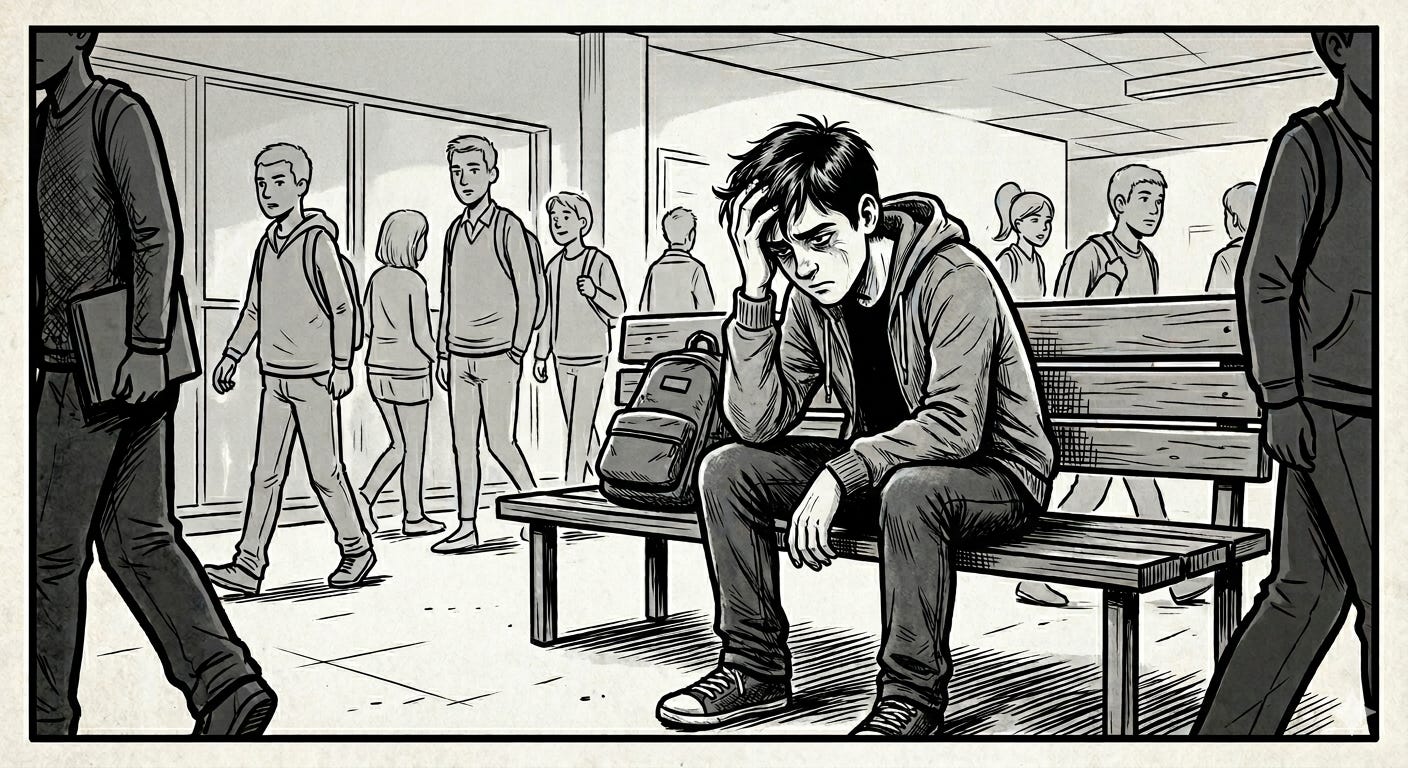
And then we wonder why so many men die from cardiovascular disease, why so many men are killed by stress, alcohol, drugs, or anger that they can’t express, but only bottle up.
The Toxic Masculinity We Created
We, men, created the patriarchy. And we don’t benefit from it either, but we won’t let go of it, because if we did, we’d have to admit that what we built hurts us too, harms us too, and kills us too. And then we’d have to give up our many privileges. But instead, we don’t complain. We endure. We swallow.
Meanwhile, there’s this mountain of expectations burned into us, that we learn before we can even speak. We have to be strong, brave, initiators, conquerors, and breadwinners. We solve everything, protect everyone, and fight against everyone. Those who don’t conform risk a lot. Not just their personality, but their gender too.
Women are allowed to ask for help. Men aren’t. Women can say it hurts. Men can’t. Women can cry. Men can’t. Don’t cry. Tough it out. You’re a man.
This is also what one of the latest documentaries, the 2026 Inside the Manosphere, is about. Although it is a rather mediocre film, it is almost unbearably oppressive; an unspoken metaphor for complete loneliness. Men who can only count on themselves, can’t lean on anyone, but everyone can lean on them, because they can endure anything.
Money, looks, and sex. The real man exists only within this triangle. This is the quintessence of masculinity.
Boys Who Can’t Be Boys
There’s another problem we talk about less often, though it’s just as serious. Boys aren’t allowed to be boys; they have to become men as quickly as possible.
When a little girl cries, we comfort her. When a little boy cries, we say: stop being hysterical, you’re a man. Only three years old, but already a man.
When a little girl is afraid, we hold her hand and reassure her. When a little boy is afraid, we say: don’t be scared, there’s nothing here.
A little girl can play with dolls, she’s sweet and nurturing, but a boy becomes girlish if he plays with dolls. But why would caring be girlish? Why would empathy be girlish? Why would it be girlish for someone to care about someone? Because boys don’t care. Boys fight.
Instead of dolls, boys get dinosaurs, soldiers, superheroes, and cars. He won’t show emotions, but he’ll know how to dominate and rage skillfully; that’s accepted, but sadness, fear, or vulnerability mustn’t be given a voice.
This is exactly the kind of social phenomenon that the already mentioned film and the manosphere in general, the Andrew Tate phenomenon, feeds on. A universe where women are reduced to tools or objects.
But crucially, men are too.
In this logic, no one is truly seen as a full human being; everyone becomes a function, a role to perform, a means to an end.
But let no one have any doubt, the manosphere is unsustainable. The manosphere is, in some respects, like a parody or a misunderstanding. Of course, you have to understand the individual suffering behind it, but on a systemic level, it’s as if we wanted to cure a precisely known disease with the same disease. The patriarchy doesn’t work, so let’s double down on it.
The manosphere locks men behind even stronger, more impenetrable steel walls than the patriarchy. And unfortunately, women too.
The Real Problem
I don’t envy men. There’s enormous pressure on them from both male and female society, from both conservative and progressive ideologies; they’re expected to be everything, yet allowed to be nothing. In the post-Me Too world, many men feel like they shouldn’t initiate, because that objectifies. Even saying hello objectifies.
Of course this is nonsense, you could say hello before Me Too and you can still say hello now, though it wasn’t very ethical or tasteful to say hello to breasts even before. But this isn’t the only misunderstanding making men’s lives harder.
The American Psychological Association has confirmed through research that men are less likely to seek psychological help, and those who do often face greater stigma than women. Help-seeking behavior is culturally coded as feminine behavior. Men who seek help are often told: “don’t be a wimp,” “don’t cry,” or “pull yourself together.”
So we socialize boys to be tough and closed off, and then we’re surprised that they became exactly that.
This can have a serious impact on court decisions in a potential divorce, but not because men don’t deserve their children or because anyone thinks they don’t love their children. In many cases, it’s precisely the social structure that shapes the outcome, often granting the mother additional rights. Because society taught us that women care and men earn money.
So the mother was the one at home with the child, she took them to the doctor, went to parent-teacher conferences, and helped with homework. Not necessarily because anyone consciously chose it this way, but because that’s how the system is built.
Of course, there are plenty, and increasingly more, exceptions. Courts may sometimes be biased, even prejudiced, and it’s also true that, to avoid conflict, men often accept decisions that are disadvantageous to them. But all of this is part of the system’s flawed operation.
It’s not just an individual or relationship issue that parents don’t communicate properly about each other; it’s a systemic problem that women are allowed to complain, while men often feel they can’t. So how would anyone know that having limited time with his child is deeply harmful to him?
So the problem isn’t necessarily the court itself, but the system that tells us that women must care, and that only they are allowed to.
Suicide Statistics
It’s a worldwide trend that men become victims of suicide far more often than women, while women attempt suicide more often.
Hungary, where the inequality between women and men is criminal, we’re at the bottom even at the EU level, has an extreme amount of suicide. In the country of barely ten million, in 2023 there were 1,593 suicides, 75% of which were committed by men.
Perhaps after reading this much text, the reason behind the gender ratio won’t be surprising: Men don’t ask for help, so for them suicide is far less likely to be a cry for help. Their suicide is final. Because they don’t expect anyone to save them. Because they learned that a man saves himself.
It’s not women, but the cult of masculinity that pushes men into various physical and mental illnesses. On average, men live about five years less than women. In every age group, in every cause of death category, men’s mortality rate is higher.
Cardiovascular disease, alcohol, and stress are all connected to the fact that men are taught not to show their emotions, not to ask for help, and to solve everything themselves. So it’s worth getting to the point that privilege doesn’t necessarily come only with advantages.
Feminism That Also Serves Men
Feminism isn’t about putting men at a disadvantage. Feminism is about how the patriarchy is bad for both of us. When women are freed from the caregiver role, men can also learn to care. When women don’t have to always be beautiful, men don’t have to always be strong. Feminism also liberates men.
Being equal, being peers, is good. Of course, it’s difficult, because things need to be debated and discussed. Democracy is in some ways much harder than autocracy, but we still haven’t really found anything better than democracy.
Yes, as a man I have to give up my privileges, but I’d gladly give up all the advantages that come with my gender anytime, if I can socially be who I am, if I can be vulnerable, sad, or aimless for no reason, and if I can ask for help. So if I don’t have to be what society projects onto my genitals.
The Single-Earner Model as a Social Myth
Not just the manosphere, but the old school patriarchy also legitimizes and maintains the myth as old as humanity itself about the fragile woman who needs protection. Except this has only really been the case since the Industrial Revolution, when some of the work moved to factories and someone had to stay home.
There were princesses and chivalric culture before that, but I wouldn’t have wanted to be a woman in the 17th century. Neither princess nor peasant. Neither was a cheerful, free life.
The forcing of women into a secondary role gained new momentum in 1950s America. American men came back from World War II, they had to be honored, and suburbanization came with big houses, white picket fences, and smiling housewives.
Beyond the fact that this model wasn’t sustainable even in the USA, Mother’s Little Helper, Valium, didn’t help the many burned out, depressed housewives, just as their husbands weren’t exactly jumping for joy during this period either.
But never mind, let’s just revive the myth, let’s just call these women TradWives. The single-earner model makes women incredibly vulnerable, but men too. The latter will have no idea not only about what needs to be done at home, but also about why everything around them fell apart, since everyone brought what society dictated.
So What Can We Do?
First of all: let’s talk. Let’s talk about what hurts. Let’s talk about what’s hard. Let’s talk about what our fears are.
Let your son cry. Hug him when he’s scared. Tell him it’s okay to show emotions. That it’s okay to be vulnerable. That it’s okay to ask for help. Don’t tell him “don’t cry, you’re a man.” Say “I see it hurts. Let’s talk about it.” But it’s also fine if you’re just quietly there together.
Don’t take the doll away from him and give him a car instead. Let him play with what he wants. Let him be caring if he wants to be caring. Don’t tell him “don’t be girlish.” Say “be who you are.”
And if you see he’s watching Andrew Tate, don’t yell at him. Talk to him. Ask him why he’s watching. What he sees in it. What he’s looking for. And explain to him that it’s not the solution. Because the solution isn’t to be even tougher. It’s to finally allow ourselves to be human.
Now think about: what do you say when your son cries? What toys do you give him? What labels do you use? “Strong boy” or “sensitive boy”? “Brave boy” or “caring boy”? And when you tell him “don’t cry,” who are you protecting? Him? Or your own expectations, which you also received, and which you’re now passing on to him?
Your son doesn’t not cry because he’s a man. He doesn’t cry because the world taught him that men don’t cry. But this is a lie. Men cry too. They just learned not to.
Let him feel.